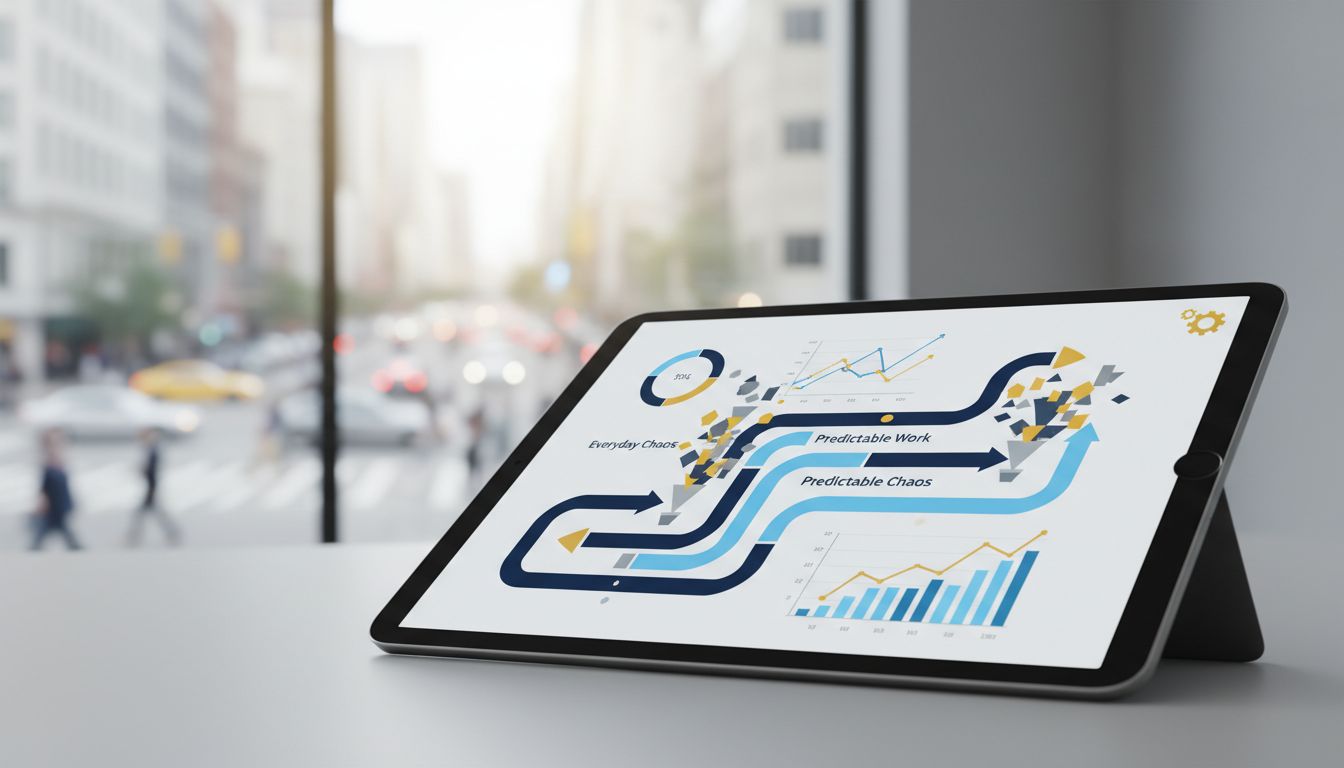

For many owner-run firms, the nearly universal bottleneck is managerial drag. The founder is still reviewing reports, chasing updates, checking exceptions, and manually connecting information across finance, operations, service delivery, and sales. As AI tools enter the business, that burden can actually grow if automation is deployed in fragments. Instead of creating leverage, scattered agents often create a new layer of oversight work. That is why more firms are adopting an agent-driven business management portal that brings visibility, control, and decision-making into one place.
The shift is less about adopting AI for its own sake and more about reclaiming hours. Owner-operators want practical gains: fewer manual handoffs, faster back-office throughput, clearer accountability, and more time spent on clients, hiring, and growth. A centralized business dashboard for agent workflows gives them that control layer. It turns AI from a set of isolated experiments into an operating model that supports scalable business systems, stronger workflow automation, and measurable operational efficiency.
The Hidden Cost of Running AI Without a Control Layer
Recent reporting has made one point clear: autonomous agents become a burden when teams run them without the right oversight. In small and midsize firms, that problem shows up quickly. An owner may approve one AI tool for inbox triage, another for bookkeeping support, and another for customer service. Each tool may work in isolation, but together they create fragmented visibility. No one can easily see what was completed, what failed, what needs review, or where time is actually being saved.
This is the root operational issue. Owner-run businesses do not just need automation; they need coordination. A true business operating system gives leaders a way to monitor agent activity across workflows, data sources, and teams. Instead of treating AI as a set of disconnected assistants, the firm can manage it as a structured layer of operational labor with rules, approvals, and performance tracking.
That is why agent-driven dashboards are gaining traction now. ServiceNow’s positioning around agent governance reflects a larger market shift toward control towers for AI work. For founders, this matters because governance is not an enterprise luxury. It is what keeps workflow automation useful, auditable, and aligned with business priorities when the owner no longer has time to manually inspect every process.
Why Reclaimed Hours Matter More Than AI Adoption Headlines
The strongest business case for AI business management is not novelty. It is time returned to the owner and the team. In Thrive Holdings’ accounting roll-up, one accountant reportedly spent 180 hours preparing tax returns the prior year and 15 hours this year after new AI software was introduced. That kind of result is easy for an owner to understand because it translates directly into capacity, responsiveness, and margin.
For service businesses especially, recurring time savings matter more than one-time efficiency wins. Saved hours can be redirected into client calls, advisory work, quality control, and revenue-generating activity. This is where a centralized business dashboard becomes essential. It helps leaders prove whether the system is actually reclaiming hours, not just producing more outputs or more notifications.
The ROI logic is changing accordingly. The question is no longer just, can the AI do the task? Increasingly, it is, can we prove the hours saved, the cost per task, and the utilization of each agent? With AI token bills rising, as TechCrunch has reported, businesses are investing in monitoring tools that tie AI activity to measurable returns. Dashboards provide that visibility and give owner-run firms a practical framework for business process optimization.
From Doer to Supervisor: The New Role of the Owner
McKinsey describes the agentic approach as elevating human workers into supervisory roles over AI agents. That is especially relevant for owner-run firms. The founder often starts as the chief doer, reviewer, and problem-solver. But that model does not scale. As complexity grows, the owner needs a system that allows them to supervise outcomes rather than execute every step personally.
Agent-driven dashboards support this transition by showing what agents did, what confidence level they had, what exceptions were triggered, and what still requires human judgment. The owner is no longer buried in repetitive work. Instead, they can manage priorities, approvals, service levels, and resource allocation from a single operational view. That is a far better use of executive attention.
This is one reason a modern small business management software stack increasingly resembles a control center rather than a collection of point solutions. The best systems do not just automate tasks. They help owners run the business through dashboards, rules, and feedback loops. In practice, that means a founder can oversee an expanding set of workflows without adding equivalent count or administrative burden.
Why Dashboards Work Best in Complex, Repetitive Workflows
AI agents tend to scale fastest where workflow complexity is high and outputs are measurable. McKinsey notes that adoption at scale is most advanced in technology functions such as software engineering and IT. The reason is straightforward: these environments have high volumes of repetitive actions, structured data, and clear performance metrics. The same logic applies to finance, insurance, operations, and other process-heavy service businesses.
When a workflow includes repeated decisions, standard exceptions, and predictable handoffs, a dashboard becomes highly valuable. It can show queue volumes, turnaround times, exception rates, approval needs, and cost trends in one place. For an owner-run firm, this visibility makes workflow automation manageable. It turns hidden operational work into something observable and improvable.
Back-office automation is approaching a tipping point in service industries. In insurance, some AI agents can autonomously resolve 90% of policy servicing cases over email and voice. That kind of capability is powerful, but only if leaders can see what was handled correctly and where intervention is required. A centralized business dashboard helps firms reclaim staff time while preserving service quality and compliance standards.
Trust, Accuracy, and the Need for Visible Governance
Trust remains one of the biggest barriers to adoption, particularly in finance and accounting. If an agent changes records, drafts communications, or completes sensitive operational steps, owners need confidence that the work is reliable. Dashboards are becoming the place where that trust is either built or lost. They expose what agents did, what humans approved, and where exceptions occurred.
That transparency matters because performance is improving quickly. Thrive Holdings says its self-improving agents are reaching up to 98% data-entry accuracy. For an owner, that metric is meaningful only when paired with operational visibility. A high accuracy number sounds promising, but a business still needs to know which transactions were low-confidence, which items were escalated, and how much manual review remains.
This is where observability and agent governance are converging into a real product category. New Relic’s 2026 AI agent platform and OpenTelemetry tools point to a broader push to manage AI agents with the same discipline applied to other critical systems. For small firms, that discipline is not just technical. It is managerial. A business operating system must make agent behavior visible enough for leaders to trust the outcomes and intervene when needed.
Turning Experiments into an Operational System
Many firms are still stuck between experimentation and scaled use. McKinsey reports that 39% of respondents have begun experimenting with agentic AI, while only 23% say their organizations are scaling an agentic AI system in at least one function. That gap is important. It shows that the challenge is no longer simply access to AI tools. The challenge is operationalizing them.
Owner-run firms feel this gap more acutely because they lack layers of management to absorb experimentation costs. A founder cannot spend months managing pilots that never become dependable systems. They need a framework that connects use cases, approvals, metrics, and workflows into one repeatable model. An agent-driven dashboard provides that structure by standardizing how automation is launched, observed, and improved.
This is also why small businesses may have more to gain than larger organizations from practical, dashboard-led adoption. Forbes, citing NFIB data, says only 24% of small businesses use AI in operations. That leaves significant room for advantage. Firms that implement AI through a disciplined business management portal can move beyond ad hoc experimentation and build scalable business systems that improve business productivity without increasing chaos.
Why Computer-Using Agents Raise the Value of Oversight
Recent advances in models that can click through software and operate interfaces like humans are expanding what agents can do. These breakthroughs make AI more useful, but they also increase the need for supervision. If an agent can navigate systems, update records, submit forms, or trigger downstream actions, then every automated step carries operational consequences.
That is why dashboards are becoming more valuable, not less, as agents become more capable. A leader needs to know not only that an outcome occurred, but how it occurred. Which system did the agent use? What fields were changed? What approvals were required? What exception path was triggered? These are not edge-case questions. They are central to running a reliable operation.
For owner-run firms, the answer is not to avoid these tools. It is to pair them with stronger oversight. A centralized business dashboard creates the observation, approval, and audit layer that makes advanced agents practical inside everyday workflows. It supports operational efficiency while reducing the risk that automation introduces hidden errors or unmanaged process drift.
How CalcX Business Management Portal Fits the Shift
As firms look for a smarter way to coordinate people, processes, and AI, the need for an integrated system becomes more obvious. This is where the CalcX Business Management Portal fits naturally. Rather than treating automation as a scattered add-on, CalcX can be understood as an intelligent operating layer for modern business growth: a place to centralize workflows, monitor execution, organize decisions, and keep the business aligned as complexity increases.
For entrepreneurs and small business leaders, that matters because growth often breaks the informal systems that worked in the early stage. A stronger business management portal helps translate strategy into repeatable execution. It supports AI business management by giving leaders a more structured view of performance, exceptions, resource use, and process health. In other words, it helps turn workflow automation into usable management leverage.
The broader lesson is that small business management software is evolving. The most valuable platforms will not simply store information or automate isolated steps. They will function as a centralized business dashboard and business operating system that helps owners reclaim time, improve business process optimization, and scale with clearer control. CalcX aligns with that direction by supporting a more connected, systems-focused way to run the company.
Owner-run firms are adopting agent-driven dashboards because time has become the scarcest resource in the business. When AI is introduced without structure, it often creates more complexity than relief. But when agents are managed through a visible, governed dashboard, they become a practical source of reclaimed hours, elastic capacity, and better decision support. That is the real value proposition behind the shift.
The firms that benefit most will be the ones that treat dashboards not as reporting tools, but as the control center for execution. With the right business operating system in place, owners can move from chasing tasks to supervising outcomes, from fragmented tools to scalable business systems, and from experimentation to measurable operational efficiency. In that environment, AI stops being a distraction and starts becoming a durable advantage.