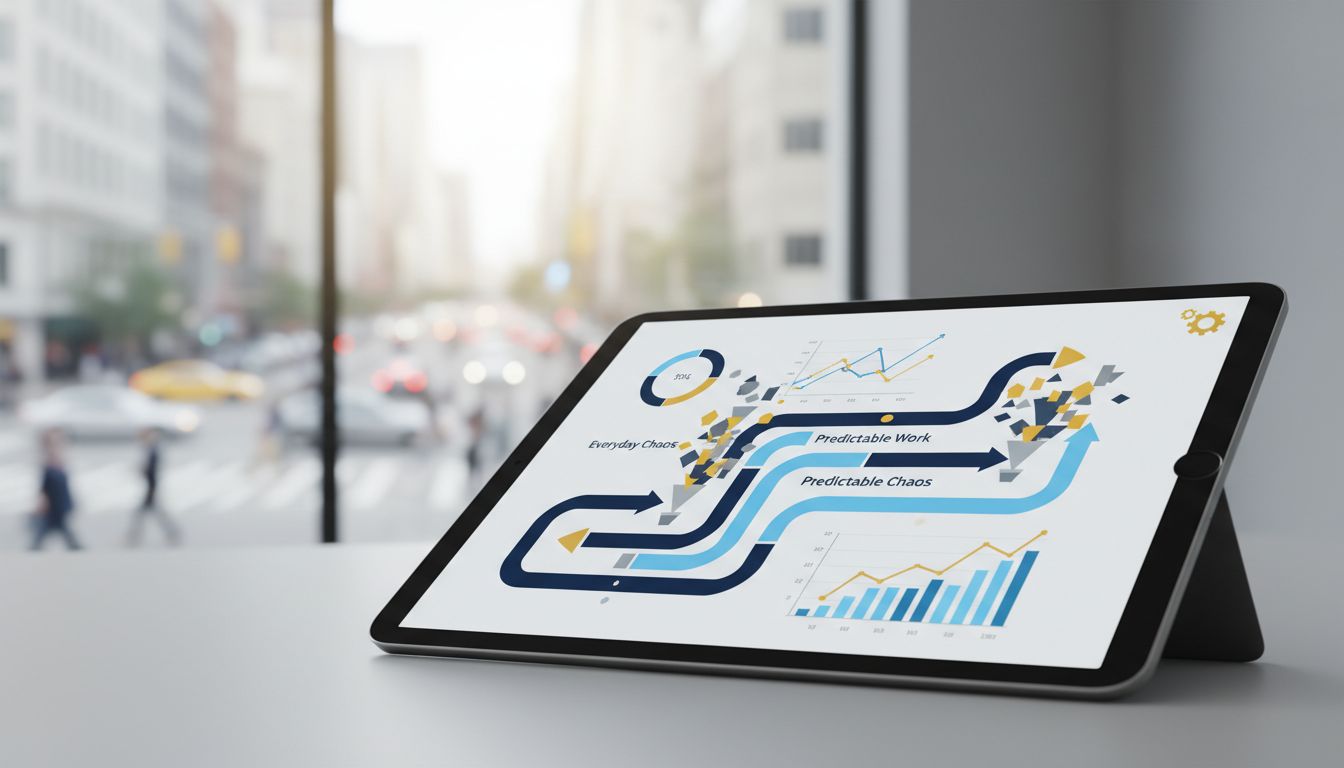

Most growing businesses don’t struggle because of a lack of tools, they struggle because those tools don’t speak to each other. Data lives in dashboards, decisions happen in meetings, and execution happens somewhere else entirely. The result is operational drag: duplicated work, delayed insights, and inconsistent decision-making.
The shift underway in 2026 is not about adding more software. It’s about replacing fragmented systems with embedded intelligence, agents connected directly to workflows, powered by live metrics, and grounded in a single, continuously updated source of truth. This is where modern business management is going, and why platforms designed as a true business management portal are becoming foundational.
From fragmented tools to operational friction
For years, companies built their operations on siloed applications, CRM for sales, ERP for finance, helpdesk for support, analytics tools for reporting. Each system optimized for its own function, but none provided a unified operational picture. Teams were left stitching together insights manually.
This fragmentation creates a deeper issue than inconvenience. It breaks decision loops. When metrics are delayed, context is incomplete, and workflows are disconnected, businesses default to reactive management instead of proactive control.
Even when dashboards exist, they often represent static snapshots rather than living systems. Without real-time context and embedded action layers, data becomes informational rather than operational, useful for reporting, but not for steering the business in motion.
The rise of embedded agents as the new interface
A major shift is happening: agents are becoming the interface to business systems. Microsoft reported in early 2026 that 80% of Fortune 500 companies are already using active AI agents embedded across workflows in sales, finance, security, and customer service.
These are not standalone chatbots. They are embedded agents, deeply integrated into tools and processes, capable of taking action, retrieving context, and coordinating workflows. Instead of navigating multiple apps, users interact with a unified layer that understands both data and intent.
OpenAI’s work with Choco illustrates this transition clearly. By embedding AI APIs across text, vision, and audio into a single ecosystem, Choco unified previously disconnected workflows into one intelligent system. The interface is no longer the app, it’s the agent operating across the system.
Why a single source of truth is now operational
The idea of a “single source of truth” is not new, but its meaning has evolved. It is no longer just about clean data warehouses or consistent reporting. It is about operational alignment,where data, decisions, and actions are synchronized in real time.
Microsoft’s Dynamics 365 positioning reflects this shift, defining unified knowledge as a single source of truth that connects workflows and insights. In this model, the source of truth is not a database,it is a living system that powers execution.
OpenAI’s internal data agent provides a concrete example. It serves over 3,500 users, spans 600 petabytes across 70,000 datasets, and retrieves only the most relevant embedded context using retrieval-augmented generation. Instead of scanning raw logs or metadata, it constructs a normalized, usable representation of business data at query time.
Embedded context replaces scattered artifacts
A recurring pattern across modern systems is the move away from scattered artifacts, documents, dashboards, and disconnected datasets, toward embedded context. Agents no longer fetch everything; they retrieve precisely what matters in the moment.
OpenAI’s approach highlights this well. Its internal systems aggregate table usage, annotations, and enrichment into a single normalized layer, enabling agents to pull context dynamically. When information becomes stale, agents can execute live queries to ensure accuracy.
This model dramatically improves decision quality. Instead of relying on outdated reports or incomplete datasets, teams operate with context that is both relevant and current, turning information into a real-time decision engine.
Live metrics turn systems into feedback loops
The second critical shift is the rise of live metrics. Static reporting is being replaced by continuous measurement, where systems monitor themselves and adapt in real time.
Microsoft’s Industry Agent Metrics, based on first-party telemetry from Copilot Studio and Agent Builder, reflects this change. These metrics track how agents perform in real workflows, not controlled environments, providing a clearer picture of operational impact.
AWS reinforces the same trend. Grupo Elfa uses AgentCore Observability to achieve complete audit traceability and real-time metrics, transforming reactive processes into proactive operations. The system doesn’t just report outcomes, it actively shapes them.
Observability and governance as growth enablers
As agents become embedded into core operations, visibility becomes non-negotiable. Businesses need to understand not just what happened, but how and why decisions were made.
Microsoft emphasizes that organizations embedding governance and controls from the beginning can move faster and build trust in AI systems. Observability, tracking agent behavior, decisions, and outcomes, is what makes this possible.
OpenAI echoes this need. Its evolving Agents SDK highlights trade-offs between ease of deployment and visibility into how agents access sensitive data. Meanwhile, internal monitoring of deployed agents is becoming essential for learning from real-world usage and mitigating emerging risks.
Security and safe tool access in connected systems
Embedding agents into workflows introduces new security considerations. When agents can retrieve external content or trigger actions, they also create new potential paths for data exposure.
OpenAI has warned that seemingly harmless actions, like loading embedded web content, can introduce exfiltration risks. This makes secure tool access and controlled environments a foundational requirement, not an afterthought.
Platforms like AWS AgentCore address this by providing secure infrastructure for building, deploying, and operating agents at scale. The goal is clear: enable powerful automation without compromising control.
Measuring what matters: from benchmarks to real environments
Another defining trend is the shift from theoretical evaluation to real-world measurement. It’s no longer enough for agents to perform well in isolated tests, they must prove reliability in operational environments.
OpenAI’s EVMbench reflects this direction, evaluating agents in economically meaningful scenarios using curated vulnerabilities from real audits. Even in controlled environments, the emphasis is on ground truth and realistic conditions.
Similarly, Microsoft Research’s WABER benchmark focuses on reliability and efficiency in web agent workflows. Across the board, the message is consistent: performance must be measurable, contextual, and tied to real outcomes.
From tools to systems: the role of a business management portal
All of these shifts point toward a new architectural model: the business as an integrated system rather than a collection of tools. This is where a modern business management portal becomes critical.
A platform like CalcX Business Management Portal acts as a centralized business dashboard where workflows, metrics, and automation converge. Instead of switching between apps, businesses operate within a unified environment where agents, data, and processes are interconnected.
This approach enables true business process optimization. Workflow automation is no longer rule-based and rigid,it becomes adaptive, context-aware, and continuously improving through live feedback and embedded intelligence.
The move beyond siloed apps is not just a technological upgrade,it is a structural transformation. Businesses are shifting from fragmented operations to integrated systems where data, decisions, and execution are tightly aligned.
Embedded agents and live metrics are the foundation of this change. Together, they turn scattered work into a single source of truth,one that is dynamic, observable, and actionable. For companies focused on scalability and operational efficiency, adopting a system-first approach is quickly becoming the only sustainable path forward.